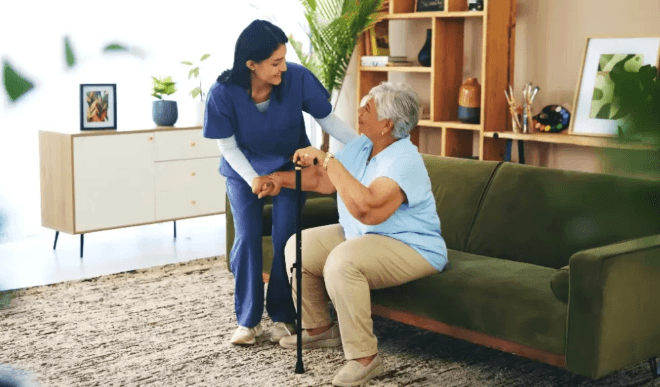

A significant proportion of people over 85 have some degree of disability that affects their ability to manage daily tasks within the home. Homes of older people can present barriers to comfort, safety and independence of older people. In many instances, strategic upgrades to homes of older people can address specific needs of the ageing person without the need for expensive major renovations. Each upgrade needs to be strategically targeted to ensure the end result is a safe and comfortable home for the ageing person living in the home.
A number of strategic home improvements that support aging in place can be put in place without the need for major renovations. Each improvement strives to create environments and spaces that are safe and comfortable for senior family members and enable them to remain at home for as long as possible.
Seating solutions that support independence
When joints and muscles become stiffer with age, people find that they have difficulty sitting down and standing up from chairs. And even when they do manage to sit down, they are often not very comfortable because they are not receiving the necessary support.
Lift Chairs are possibly the biggest breakthrough in senior seating to date. With the touch of a button, a Lift Chair will lift up to assist the user in sitting or standing. This takes the struggle out of these activities for seniors suffering from joint stiffness and muscle weakness while still seated in a chair in their lounge. The cost of a lift chair will be of little consequence when a senior is able to use their lounge again without needing assistance for everyday activities.
The ideal chair would have heat and/or massage in the seats and back, to help alleviate issues with poor circulation and joint pain. As well as being able to sit and relax in the chair, there are many recliner chairs positions to assist with reading, watching TV etc. Also ensure that the controls are easy to use, and safe for the elderly person to use independently. While functionality is important, the elderly person’s dignity is more important, so make sure that they are not embarrassed using the chair.
Bathroom modifications for safety and dignity
Grab bars and support systems
Falls in the bathroom can result in serious injury for older people and can be caused by a slip on a wet surface, struggling to move around on a hard floor, or reaching for items at height or below.
Grab bars can be fixed in place in the bathroom to provide support for senior citizens. Typical positions for grab bars are next to the toilet, in showers and near baths. Before installing any grab bar it is very important to ensure that the product is suitable for fixing into the type of walls that you have. The vast majority of grab bars are fixed into the wall studs, however some are designed to be fixed using a specialized mounting system. It is vital to avoid cheap suction-cup type products which are not strong enough to hold body weight and are likely to fall when most needed.
When choosing a shower seat there are several features to look for. First of all there is the option of whether or not the seat has a drain hole in the base of it. This can be a big plus for those with mobility problems as it stops soap and water from building up around the base of the seat. It is also a good idea to check the feet of the seat for non-slip material. This can stop the seat from moving around in the shower. There are also different heights of shower seats. There are some that are fixed at a height and do not come down. These seats are usually for people who have someone to help them in and out of the shower. There are also seats that are adjustable, these seats are for families, this way everyone can use the seat at a height that is suitable for them.
Toilet modifications
For toilet transfers, raised toilet seats or elevated height toilet seats are extremely beneficial as they reduce the strain put on the senior’s knees and hips when lowering themselves down to the toilet. Some models of these products also come equipped with armrests which can assist in the transfer process of getting on and off the toilet.
A walk-in bath is a good idea for people who have mobility problems and need to use a bath. These solutions can be very expensive and take weeks to install. However for families with a senior who has mobility problems it can be a safe solution for them to help them to have a bath.
Lighting and visibility improvements
As people age, their vision can change in many different ways. Home lighting schemes are often designed for average age able bodied people, but for many older people home lighting can cause problems. There are many simple devices available that can help, such as, automatic external lights that are activated by a persons movement. These can be set up and running in minutes, with battery powered versions not requiring any electrical work to be carried out.
Task lighting enables people with impaired vision to complete specific tasks. Under cabinet lighting in the kitchen, reading lights that can be moved about as required, and adequate lighting for work areas are examples of task lighting.
Making contrast between objects and the background of a space is an easy thing to do in order to help seniors with visual impairments. For example, a colored toilet seat as opposed to a white one, colored electrical switches on a light colored wall as opposed to white ones, and dark colored handrails on a light colored wall as opposed to white ones are just a few examples of simple modifications that can be made to help a senior with visual impairments to safely live in their own home.
See also: How Artificial Intelligence Is Used in Smart Homes
Technology integration for peace of mind
Using technology that can be monitored by the elderly person’s family can mean that they can live safely and independently in their own home for longer. Some people may think that older people do not want to use technology but this can be introduced to them in small steps with their family’s support. It is also important that the technology is user-friendly.
A Medical Alert System is more than just a simple pendant that the elderly can wear around their neck. There are many different systems available that can include fall detection, GPS tracking for when the elderly go outside for walks, and two-way communication. Some systems can even be integrated with your home automation system to allow for complete monitoring.
Smart home technology can also be implemented in homes to help keep senior family members safe and to provide them with peace of mind and connection with family and friends. Smart technology in the home can be set up so that senior family members can use voice commands to turn on lights, adjust the temperature and play music and movies. Large screen TVs with video calling apps can also be set up for senior family members to make video calls to loved ones that live miles away. Depending on how much technology the senior and their family use, it can take a little time to get used to but with the right set up and training, it can be very easy to use.
Financial considerations and implementation
Home safety modifications can cost a few thousand dollars to install, but in the long run this could save hundred of thousands of dollars compared to the cost of residential care, which can cost up to $600 per day. Many home modifications are eligible for government rebates and can be claimed as a medical expense.
Start with the absolute necessary safety features in the bathroom and seating then work your way through to the features of convenience. By getting a professional, preferably an Occupational Therapist who can come to your home to assess your needs he/she can then give you a list of suggested modifications to aid your independence. As mentioned before some of these modifications can be quite costly and for many be outside of their budget.
The home is where many people with disabilities and elderly people want to grow old in safety and comfort while maintaining their independence. Making changes to the home to support a person’s safety and independence is often the main goal of home modification. These changes not only support a person’s physical needs but also their psychological needs and help to maintain their dignity by enabling them to feel safe and independent in their own home.


 By
By